Coastal Style in a Compact Singapore Home: Space-Smart Furniture Choices
I will be honest with you. When my colleague Priya asked me to help her look at furniture for her new 538 sq ft two-bedroom flat in Punggol last month, I thought coastal style was a strange fit. Her lift opening onto the 12th-storey corridor measured only 1.1 m wide, the bedroom door was 0.82 m, and the corridor between her dining nook and the kitchen was a tight 1.5 m. Yet three weeks later, after we placed a single MIDHILL solid oak extendable dining table, a 1.5 m ash-veneer wardrobe, and two narrow bedside tables from the same maker, the flat looked about 20% larger than it actually is. None of it felt like clutter. That is the point of coastal style in a small Singapore home: pale timber, low visual weight, and a single horizontal line through every room.

Singapore's compact flats demand a specific kind of coastal style. The HDB standard ceiling sits at 2.55 m to 2.75 m, the average bedroom floor plan in a 4-room BTO in Tampines or Bedok runs 9 to 11 sq m, and the dining area often shares a wall with the kitchen. After sixteen years of outfitting homes across Tampines, Bedok, Punggol, Sengkang, and the Bukit Timah condos, I have learned that coastal style in this context is less about seashells and more about the discipline of editing. Below is the long-form guide I wish someone had given Priya on the day she signed her lease.
Why does coastal style work so well in Singapore HDB flats under 600 sq ft?
Coastal style works in compact Singapore flats because its core design language is built on reducing visual weight, and HDB rooms under 10 sq m cannot afford any unnecessary visual load. The palette is pale: whitewashed oak, natural ash, ceresin-tinted teak, sometimes a chalky blue-grey accent wall in one room only. The silhouettes are low, with sofa seats at 42 cm, dining tables at 75 cm, and bed frames usually under 1.1 m at the headboard. The materials breathe, meaning solid wood with a matte oil finish rather than high-sheen laminates that reflect corridor lighting and make a 1.5 m passage feel tighter than it is.
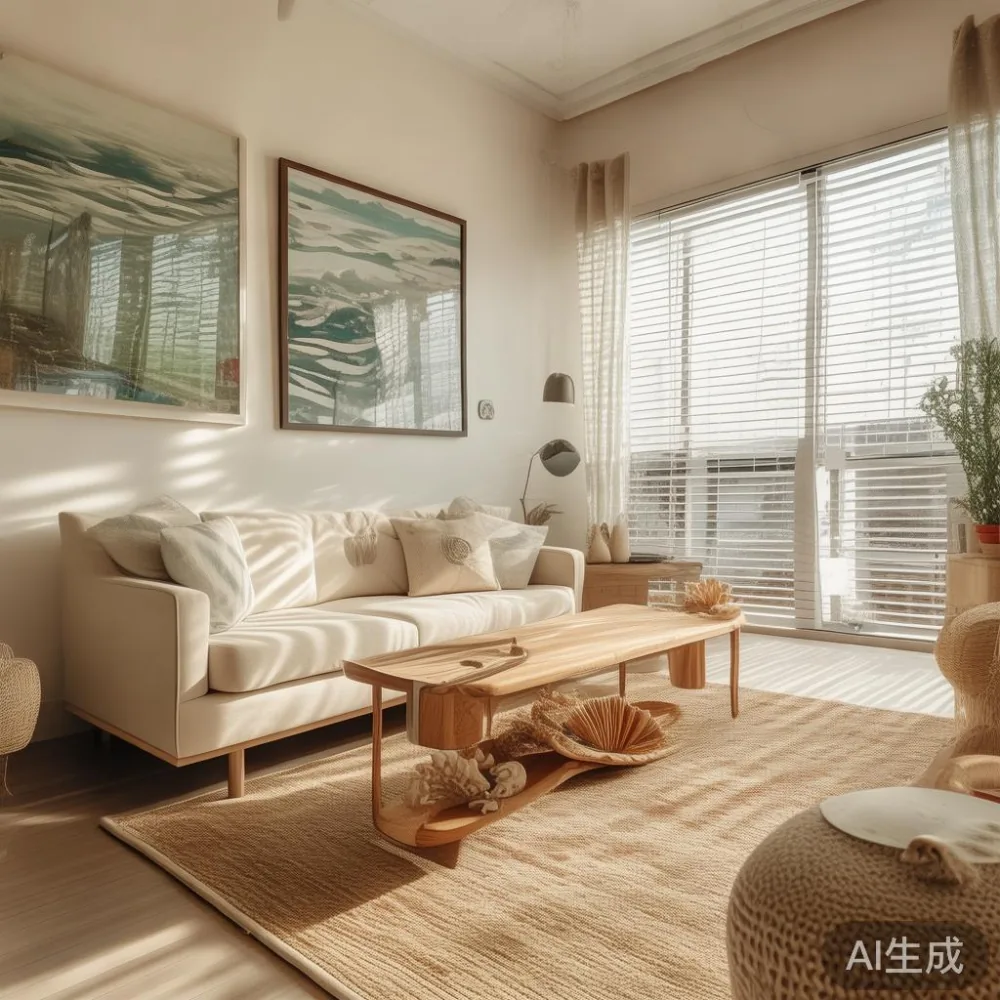
The coastal palette also pairs with Singapore's natural light profile. North-facing flats in Punggol get soft, indirect daylight that warms pale oak around 9 a.m. and again at 4 p.m. South-facing units in Bedok get harsher midday light, which washes out cool greys and rewards warmer teak. If your window faces a corridor or another block, the pale tones of coastal style bounce what little light you have around the room instead of absorbing it. That is the first design trick: let the walls, the floor, and the largest furniture pieces share the same light value, and the eye reads the room as one continuous space rather than four chopped corners.
You will see coastal style referred to as American light luxury in some Singapore catalogues, because American light luxury coastal leans into deeper seat cushions, brass accents, and slightly warmer wood tones such as aged oak or honey teak. The French light luxury version pulls cooler, with a chalkier white, cabriole legs on nightstands, and a touch of cane webbing on a chair back. Post-modern light luxury sits in between, often with a marble table on a brass base replacing the traditional solid wood coffee table. All of them, when chosen correctly, work in a 9 sq m bedroom. The mistake is mixing two of them in one flat, which I will return to later.

What is the difference between French provincial king bed and modern furniture?
The difference between a French provincial king bed and modern furniture is that French provincial king beds carry carved detailing, scrolled headboards, cabriole legs, and a warmer painted or limed-oak finish rooted in 18th-century French country estates, while modern furniture prioritises clean horizontal lines, exposed joinery, matte finishes, and minimal ornamentation rooted in 20th-century Scandinavian and Bauhaus principles. In a Singapore HDB under 600 sq ft, this difference matters because a carved French provincial headboard typically runs 1.35 m tall and protrudes 6 to 8 cm further from the wall than a flat modern panel headboard, eating roughly 0.2 sq m of visible wall area you can never recover. The coastal-style modern king bed, by contrast, sits on a low 15 cm plinth, has a headboard between 95 cm and 110 cm, and finishes in a chalky limewash that recedes against a pale wall. Both can be technically a king, both can be technically a bed frame, but only one of them will let a 9 sq m bedroom breathe.
Which coastal style furniture pieces actually earn their floor space in a compact flat?
In a compact Singapore flat, the coastal style furniture pieces that actually earn their floor space are the ones that do at least two jobs, weigh under 35 kg so a single delivery crew can move them through a 1.1 m lift and along a 1.2 m corridor, and read as one quiet horizontal line against the floor.
For the living area, a 1.8 m solid wood sofa with a 65 cm seat depth and removable washable linen covers gives Priya three full seats without protruding into the corridor. A 90 cm round marble table replaces the usual 1.2 m rectangular coffee table: it takes up 0.64 sq m instead of 0.96 sq m, and the soft curve keeps the eye moving. The marble is a coastal-style grey veining, not a dramatic black or gold, so the table sits as a quiet companion to the sofa rather than a statement piece that crowds it. Lift door clearance is usually 2.1 m high and 0.9 m wide on a passenger lift, so a marble table top under 0.9 m wide in its packaging will go in without tipping the lift crew.
For the dining area, a solid wood dining table that extends from 1.2 m to 1.6 m with a butterfly leaf gives you four seats on a Tuesday and six on a weekend, without owning a second table you do not have space to store. Priya's MIDHILL extendable table weighs 38 kg in oak, which two movers can carry up the service lift on a Saturday morning in about 12 minutes from kerb to her dining nook. The chairs are stackable, 45 cm wide, with arms omitted, so four chairs slide under the table at 75 cm height and disappear.
For the bedroom, a king bed frame at 1.8 m by 2 m, a 1.5 m sliding-door wardrobe, and a single 45 cm nightstand per side is the maximum load the room can carry. A second nightstand on the same wall as a window eats morning light. If you need drawer space, choose a bed frame with two under-bed drawers rather than buying a separate tallboy, because a tallboy in a coastal style still wants 50 cm of depth and 1.2 m of height that you cannot spare.
For the entryway, a 60 cm bench with two shallow drawers handles shoes, keys, and the random Singapore habit of receiving multiple parcel deliveries a week. A 60 cm-wide piece clears the typical HDB entry corridor of 1.05 m without forcing anyone to step sideways.
How do you keep coastal style from drifting into clutter?
You keep coastal style from drifting into clutter by setting three hard limits before you buy anything: no more than three wood tones in the whole flat, no more than one piece of furniture per wall in any single room, and no decorative object smaller than 15 cm above eye level on any open shelf. Those three rules, written on a piece of masking tape and stuck to the inside of a kitchen cabinet, prevent the drift I see in most small Singapore flats: too many rattan baskets, too many framed prints, too many fake plants. In a 538 sq ft flat, every extra object is paying rent to your eye.
The wood-tone rule is the strongest. Coastal style in Singapore flats should read as one warm pale oak, with possibly one accent of darker teak used on a single piece such as a black teak chaise lounge in the corner of the bedroom, or on a small picture frame above the dining table. If you buy a dining table in oak, a wardrobe in ash, and a bed frame in walnut, the room will feel busy even though all three are technically wood. Limit the palette, limit the visual noise.
The one-piece-per-wall rule stops you from buying a sideboard, a console, and a bar cabinet in the same 2.4 m of dining wall. Pick one. The console wins for most Singapore flats because it doubles as a TV stand for a 43-inch screen, which is the largest TV you should hang in a 9 sq m living area. Anything bigger sits uncomfortably close to the viewer.
The 15 cm minimum for open-shelf decor stops the small clutter: the 6 cm ceramic vases, the 8 cm photo frames, the 4 cm candles. Replace them with one 25 cm stoneware vase, one 18 cm framed print, and one 20 cm hardcover book with the spine facing out. Three is enough; you stop looking at the shelves.
What delivery, warranty, and after-care questions should you raise with the retailer before paying GST?
Before paying the 9 % GST on a coastal-style solid wood set in 2024, raise four practical questions with the retailer: total weight of each piece, packaging dimensions against your lift, warranty on structural joints, and what happens if the finish dulls after three years. In Singapore, MIDHILL's lift-friendly policy matches most compact-flat needs: pieces under 45 kg per carton go through a standard 1.1 m HDB lift without tilting, and heavier items such as a marble table base or a king bed frame are scheduled for the service lift with two movers. Free shipping thresholds matter here too; MIDHILL's free shipping over US$350, which is roughly S$475 at the current 1.35 exchange rate, is easy to clear on a single sofa, and you avoid the typical S$60 to S$120 Singapore delivery fee that domestic retailers add below that mark.
Structural warranties matter for solid wood in our climate. Singapore sits between 24 °C and 33 °C with humidity that holds at 80% to 90% for most of the year, and air-conditioned rooms drop to 22 °C at 55% humidity every night. That 35% swing in humidity is harder on solid wood than any UK or European climate. A 10-year structural warranty on a bed frame, a wardrobe, or a sofa frame is not a marketing line; it is the difference between replacing a cracked headboard in year four and getting the joint re-glued at no cost. Ask the retailer for the warranty document in writing, and check whether it covers humidity-related warping or only manufacturing defects.
After-care is the third question. MIDHILL offers lifetime refinishing on its solid wood coastal pieces, meaning you can send a 10-year-old oak dining table back to the Foshan workshop for a re-sand and re-oil for a small transport fee. For Singapore owners, that usually means a 6 to 8 week turnaround with sea freight, which is workable because the table is not your only dining surface. A retailer that does not offer refinishing is asking you to throw the piece away in year fifteen, which is the actual lifespan of a well-kept solid wood dining table.
Finally, ask about returns. A 14-day return window is short for furniture, but it is the standard in Singapore for online furniture sales under the Consumer Protection (Fair Trading) Act. Photograph the piece in its packaging on day one, photograph the unpacked piece on day three, and keep the courier's signed delivery note. If a crack appears in week two, you have evidence.
How do you place coastal style furniture so a small HDB looks larger than it is?
To make a small HDB look larger than its floor plan, place the largest piece of furniture in every room against the longest uninterrupted wall, lift all furniture 8 cm off the floor on tapered feet so the eye reads under it, and keep the largest horizontal line in each room below 1.5 m above the floor. Those three placements are the entire spatial logic of coastal style in compact Singapore flats, and they work because the brain registers floor continuity as room size, not as ceiling height.
In Priya's living area, the 1.8 m solid wood sofa sits against the 3.2 m living wall, not centred, but pushed 40 cm from one end so a 60 cm floor lamp can sit at the corner. The lamp gives vertical light at 1.7 m, which the brain reads as ceiling height even though the ceiling is only 2.6 m. The marble table sits 35 cm off the sofa, close enough to reach from the seat, far enough to walk around. The 43-inch TV hangs on the wall opposite, at 1.4 m centre height, which is 10 cm lower than the standard recommendation because the eye line from the sofa is lower for a 42 cm seat than for the usual 45 cm sofa seat.
In the bedroom, the king bed frame sits centred on the 2.8 m wall opposite the wardrobe, with a 45 cm nightstand on the side closest to the door and no nightstand on the window side. The single nightstand is a deliberate choice: two nightstands would push the bed 10 cm further into the room and steal morning light from the window side. The wardrobe is the 1.5 m sliding-door model, not the 1.8 m hinged-door model, because sliding doors need only 6 cm of clearance at the side rather than the 60 cm a hinged door needs to swing open. That 54 cm of clearance is exactly the depth of a narrow study desk if Priya ever wants to add one along the wardrobe wall later.
In the dining nook, the extendable dining table sits with its long edge parallel to the kitchen counter, 75 cm away. Two chairs slide under; the other two stack against the wall on a 4-peg hook at 1.2 m. When extended for a six-person weekend dinner, the table grows to 1.6 m, which still fits between the kitchen counter and the opposite wall because the original gap was 1.3 m and the un-extended table only takes up 1.2 m. That is the kind of calculation you do once, on graph paper, before you order anything.
Final thoughts on coastal style in a 538 sq ft Singapore flat
Coastal style in a Singapore HDB or small condo is not about buying more things in pale colours. It is about choosing fewer pieces, in fewer tones, with feet that lift them off the floor and silhouettes that stay below 1.1 m at the headboard. It is about asking your retailer the boring questions on weight, warranty, refinishing, and lift clearance before you pay the GST, not after. And it is about accepting that a 9 sq m bedroom can hold exactly one king bed, one 1.5 m wardrobe, and one nightstand, and that adding a fourth piece will cost you the room.
When Priya sent me a photo of her finished Punggol flat last week, the dining table was extended for a Sunday lunch with six friends, the marble table held two cups of tea and a stack of magazines, and the bed frame's under-bed drawers held the linen and the spare bedding. Nothing has been crowded. The flat is open, and coastal style did exactly what it should: it gave her a home that breathes.