Coastal Style, Real Corridors: A Singapore Buyer’s Guide to Online Furniture Delivery and Assembly
I bought a coastal-style solid wood dining table from a Foshan workshop last year. The listing promised free shipping over US$350, a 10-year structural warranty, and lifetime refinishing. What the listing did not promise was that I would spend forty-five minutes in my Tampines HDB corridor trying to rotate a 2.1-metre box past a neighbour’s shoe rack. That single afternoon taught me more about buying solid wood furniture online than any product page ever could. If you live in a Singapore flat — Tampines, Bedok, Punggol, Toa Payoh, wherever — the gap between a glossy checkout screen and the box at your door is where the real story lives.

This guide walks through the delivery and assembly realities you actually face, from lift dimensions and corridor turning circles to GST handling and what to do when the legs of your new marble table wobble on day three. I have also woven in pricing in SGD, the product categories you are most likely to shop for online (solid wood sofa, bed frame, dining table, wardrobe, nightstand), and a coastal design sensibility that suits the light and humidity of an HDB or condo in the tropics. Where helpful, I will reference the kind of support you should look for in a seller — including a Foshan-based maker like MIDHILL, which has shipped into Singapore for years and publishes clear structural warranties and refinishing terms — because good service changes the entire experience.
What does a coastal-style home actually look like in a Singapore HDB?
Coastal style is not nautical kitsch. Done well, it is pale oak and whitewashed teak, linen-blend upholstery, woven rattan, brushed brass hardware, and just enough texture to soften the glare of a tropical afternoon. In a 990-sqft Punggol HDB with floor-to-ceiling windows facing the strait, coastal style feels like an extension of the view — bleached, breathable, and quietly expensive. Pieces tend to be low-slung and unfussy: a chunky solid wood dining table with a hand-planed top, a headboard panel wrapped in oatmeal boucle, a nightstand with a single drawer and tapered legs, a wardrobe with reeded glass rather than mirrored panels.
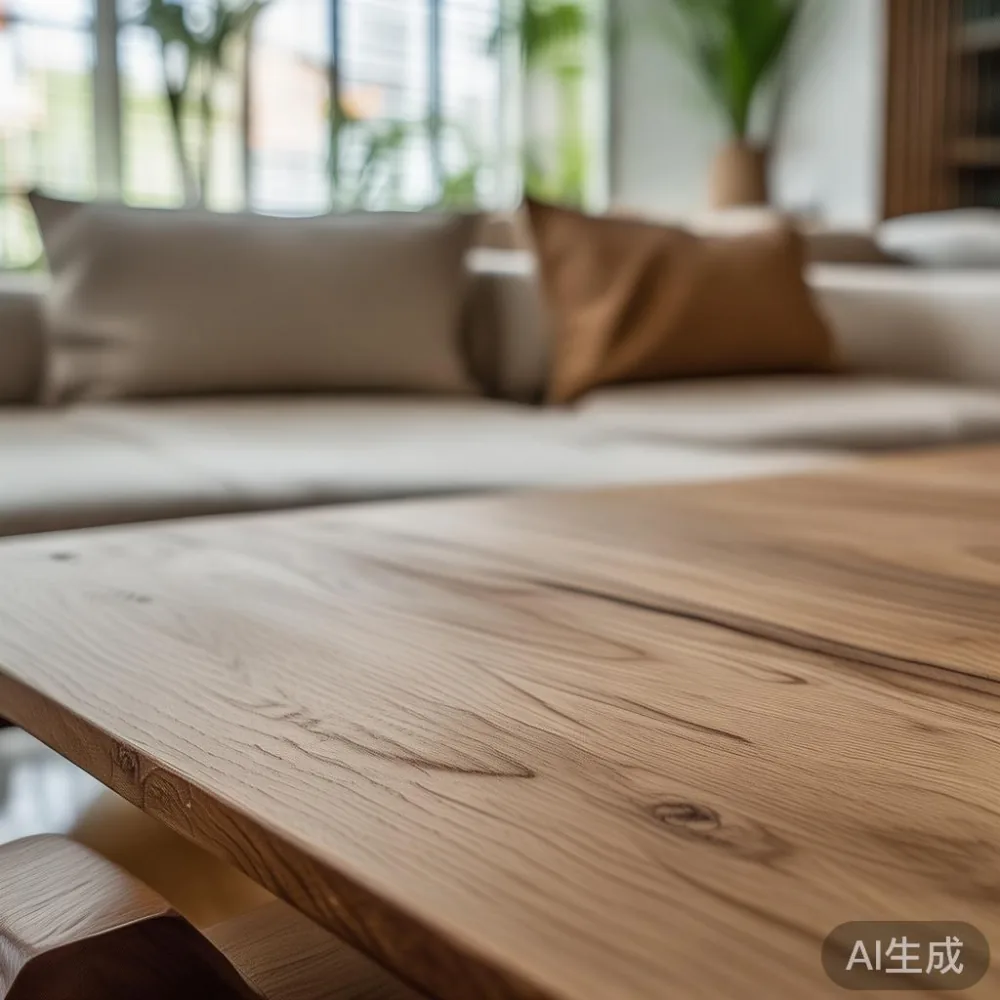
The colour palette sits around warm white (Benjamin Moore White Dove, Farrow & Ball Ammonite, or a local equivalent like Nippon NDW9102N), driftwood taupe, sea-glass green, and sand. Marble, when used, is usually honed Carrara or a pale Crema Marfil — never glossy black. The frame material is almost always solid wood, because coastal style depends on visible grain. Veneers look wrong; they catch the light flatly. If you are shopping online, ask the seller for a close-up of the end grain at the table edge. Real solid wood shows long parallel lines; veneer shows a repeating pattern every 30 to 40 cm.
One practical note: coastal style and Singapore humidity are friends, as long as the wood is properly kiln-dried. A good workshop air-dresses timber for 4 to 8 months and then kiln-dries it to 8 to 10 percent moisture content. A careless workshop ships wood at 14 to 18 percent, and you will see movement — cupped table tops, sticky drawers, hairline splits at the joints — within the first wet season. This is where a maker with a real warranty becomes more than a marketing line. A 10-year structural warranty on a solid wood bed frame is meaningless if the workshop will not answer the phone in month thirteen.

How wide is a Singapore HDB corridor, and will my new bed frame actually fit?
Most Singapore HDB corridors are 1.2 to 1.5 metres wide, with a turning radius at the stairwell of roughly 1.8 metres. Passenger lifts in newer BTOs are typically 1.1 m wide x 1.4 m deep with a 2.1 m door opening; older lifts in Bedok and Tampines can dip to 0.9 m wide x 1.2 m deep. Service lifts are larger — often 1.5 m x 2.0 m — but require booking and a lift card.
A solid wood coastal bed frame in king size is roughly 190 cm x 210 cm externally, plus packaging. Even disassembled, the headboard panel alone can run 200 cm x 110 cm x 12 cm and weigh 28 to 35 kg. That package will not corner into a 1.2 m corridor at an angle; it needs a straight run or a generous turning arc. A marble table top for a six-seater, even in its crate, is often 160 cm x 90 cm x 15 cm and can weigh 70 to 90 kg — two fit adult carriers minimum, and the lift must hold at least 400 kg for that single item.
Measure your own corridor and lift before you order. Bring a tape measure to the lift lobby on a weekday afternoon when no one is moving house. Note the door width (usually 90 cm for HDB main doors), the corridor width at its narrowest point, and whether your lift has a mirror (older lifts do, which eats 5 to 8 cm of usable depth). Then ask the seller for the fully packed dimensions of every piece, not just the assembled dimensions. A 180 cm dining table that arrives in a 195 cm box is a different proposition from one that arrives in a 130 cm flat-pack. Solid wood, by nature, ships more like the former — and that is a design feature, not a flaw, because flat-packed solid wood with through-tenons cannot be knocked down repeatedly without loosening.
I learned this with my own dining table. The assembled top is 210 cm x 95 cm; the box was 225 cm x 110 cm x 25 cm, 78 kg total. It would not have entered my old Bedok flat’s lift. I am now in a Punggol condo with a service lift, which solved the problem, but only after I paid a S$120 stair-climbing fee to the previous delivery team who refused to attempt the older lift. Plan ahead and you avoid that phone call.
How long does delivery take from a Foshan workshop to a Singapore address?
For a Foshan-based maker like MIDHILL shipping into Singapore, the realistic timeline is 35 to 55 days door-to-door for made-to-order solid wood pieces, and 15 to 25 days for in-stock items. The split matters: in-stock means the piece is sitting in a Guangdong warehouse and can be container-loaded within a week, whereas made-to-order means your bed frame or wardrobe enters production after a 30 percent deposit lands and may sit in finishing for 7 to 14 days before packing.
Sea freight from Yantian or Shekou port to Singapore PSA Terminal takes 5 to 7 days, plus 2 to 4 days for customs clearance and last-mile delivery booking. GST is charged on the landed value of the goods at 9 percent (current rate as of 2024–2025), and a typical CIF order of S$3,000 in furniture will attract roughly S$270 in GST, which the logistics agent handles on your behalf. Some sellers absorb GST for orders above a threshold; ask before you pay the deposit. For orders below S$400 in customs value, GST is not collected, which is why many online listings show two-piece bundles at sub-S$400 — a structural pricing decision, not a coincidence.
Once the piece lands in Singapore, expect a 3 to 7 day window for the local delivery team to contact you, schedule a slot, and arrive. Saturdays are tighter than weekdays; Sunday delivery is rare and usually carries a S$60 to S$120 surcharge. If your block has a loading bay access window (many new condos restrict movers to 10am–4pm on weekdays only), tell the delivery coordinator in writing before you confirm the slot. I have seen an entire dining set sit in a Tuas warehouse for nine extra days because the buyer forgot to mention a condo MCST rule.
What does assembly actually involve for solid wood coastal furniture?
Solid wood coastal pieces are intentionally simple to assemble, because the joinery is the point. A typical solid wood dining table ships in two cartons: the tabletop and the leg/trestle base. You will need an electric drill with a 6 mm hex bit, a rubber mallet, a 10 mm open-ended spanner, and a second pair of hands. Budget 30 to 60 minutes for a dining table, 45 to 90 minutes for a king-size bed frame (the side rails are heavy, 18 to 25 kg each), and 90 to 150 minutes for a three-door wardrobe because the carcass sections are 35 to 45 kg apiece and need to be lifted onto a base rather than slid.
Most coastal-style beds use a bolt-and-dowel system where the headboard brackets slot into pre-drilled holes on the side rails. The bed slats then drop into a recessed lip — no screws, which is intentional. If your bed arrives with a slat system that requires you to screw each slat individually (12 to 24 screws), return it; that is a hospitality-grade bed being dressed as residential. A genuine residential-grade coastal bed should take one person 50 minutes and leave them with a flat-head screwdriver in their hand, not a drill.
For a marble table — say, a 120 cm round honed Carrara piece on a solid wood trestle — assembly is genuinely one-person, twenty minutes. The top ships in a separate crate with foam corner protectors and a timber A-frame. You remove the frame, lift the top onto the trestle (40 to 55 kg depending on thickness), and the supplier has pre-attached a set of cork-and-rubber bumpers that mate with the trestle’s receiving pads. Do not over-tighten the receiving bolts; marble cracks under point pressure. If you hear a creak when you sit the top down, lift it back off and re-check the alignment.
A word on nightstands. They are the most underestimated piece in the coastal range. A solid wood two-drawer nightstand weighs 18 to 28 kg fully built, but ships mostly assembled because the drawer slides are factory-fitted. You only need to attach the handles (four screws, a Phillips head, five minutes). If your nightstand arrives flat-packed with twenty-plus separate components, it is MDF with a wood-effect laminate, not solid wood. The price will tell you — under S$280 for a solid wood nightstand is suspicious in 2025.
How do I style a French neoclassical headboard in a small apartment?
Choose a low-profile French neoclassical headboard in a lime-washed oak — under 110 cm tall, with a gentle camelback silhouette rather than a tall caned crown — and float it against a warm white wall 10 cm proud of the bedframe to keep the coastal look breathable. Skip the matching footboard; pair the headboard with a simple solid wood platform bed in the same coastal style so the eye reads one piece of furniture, not two competing ones.
Small apartment rules are non-negotiable. A king bed in a 3.2 m x 3.4 m bedroom leaves 70 cm of walking space on each side if you push it into a corner, which is workable but tight. A super-king will not fit, period. Measure before you fall in love with a Pinterest image. The headboard should not exceed the width of the bed by more than 5 cm on either side, or it visually pushes the room outward. Keep bedding in oatmeal, warm grey, and a single accent — a single ochre pillow, not three — and the room reads as coastal light luxury rather than Parisian maximalism.
What does French light luxury actually mean in practice? It is the restraint of classical proportion (symmetry, modest ornament, a sense of architectural weight) married to the materials of casual coastal living (pale wood, linen, unpolished stone). You see it in the way a reeded wooden bedside lamp sits on a honed marble coaster; in the way a wardrobe with fluted glass panels catches the morning light without shouting. American light luxury, by contrast, leans into softer geometry and oversized comfort — a deep-seat solid wood sofa with a single bench cushion, a chunky dining table with a hand-hewn top — while post-modern light luxury plays with curves and colour: an arched headboard in moss green boucle, a kidney-shaped marble table on a brushed brass plinth. None of these styles is coastal on its own, but each can be made coastal through material and palette. Pick the geometry that suits your flat, then soften it with sand-coloured textiles and unfinished oak.
What should I do if my delivery arrives damaged or wrong?
Photograph the unopened box on the pallet before the delivery team leaves. Photograph each opened panel. Photograph any scuff, crack, dent, or moisture stain within the first ten minutes. Then write an email to the seller with the photos attached, the order number, and a single sentence describing the issue. Keep the packaging for at least 14 days — Singapore’s consumer protection (under the Consumer Protection (Fair Trading) Act) gives you a window to escalate, and you cannot return a piece in a different box without risking a dispute.
For a Foshan-based seller shipping into Singapore, the resolution path is usually: photos reviewed within 48 hours, replacement parts dispatched via air freight in 7 to 14 days, or a partial refund of 10 to 30 percent for cosmetic issues that do not affect structural integrity. A seller with a 10-year structural warranty and lifetime refinishing — which is the kind of package MIDHILL publishes — will treat a cracked dining top or a warped wardrobe side as a workshop problem, not a customer problem. A seller without those terms will tell you that wood “moves naturally” and that you should have humidified your flat. Humidifying is good practice (target 45 to 55 percent RH in Singapore’s 80-percent ambient), but it does not excuse a manufacturing defect.
For assembly damage — a stripped bolt, a snapped slat, a cracked marble corner during lifting — photograph and report the same day. Do not attempt a repair with hardware-store filler or wood glue; the warranty becomes void the moment you alter the piece. Wait for the seller’s instruction. Most coastal-style workshops will send a replacement part and a prepaid return label for the damaged component. The whole loop usually closes in under three weeks.
Are there hidden costs I should budget for beyond the sticker price?
Yes. Build a line-item list before you pay the deposit, not after. Typical add-ons on a S$4,500 coastal-style order to Singapore: GST at 9 percent (S$405), stair-climbing or long-carry fee (S$80 to S$200 per floor if there is no lift access), disposal of your old furniture (S$60 to S$150 per piece), assembly service if you do not want to DIY (S$120 to S$280 depending on piece count), and a S$50 to S$100 surcharge for evening or weekend slots. Add them up and you are looking at S$700 to S$1,200 in soft costs on top of the furniture price. That is 15 to 25 percent of the order value, and it is real money.
Free shipping promotions are usually framed around a USD threshold (US$350 in the case of MIDHILL, for example) but read the small print. Free shipping often means free shipping to the Singapore warehouse, not free shipping to your HDB door. The last-mile fee from a local 3PL to your flat is a separate line item, and it is where the margin lives. Ask for an all-in delivered price in SGD, inclusive of GST, before you confirm. If the seller cannot give you one, find a seller who can.
What if my entryway furniture for living room arrives before the bedroom pieces?
Stage the delivery by room, not by order. A coastal-style entryway furniture for living room set — a console table, a bench, a round mirror — usually ships in three to five cartons and can be moved by one person. The bedroom set (bed frame, two nightstands, a six-door wardrobe) is heavier, slower to assemble, and more sensitive to corridor constraints. If your order is split across two shipments, ask the seller to hold the bedroom shipment at the local warehouse for seven to ten days while you clear and assemble the living room pieces. Most Foshan sellers will warehouse your order free of charge for up to 30 days; after that, storage fees of S$2 to S$5 per carton per day start to accrue.
This staging also helps you acclimatise the wood. Solid wood that has spent six weeks in a sealed container at 18 percent moisture needs 7 to 14 days in your flat’s ambient humidity (Singapore averages 78 to 82 percent RH) before the grain stabilises. If you assemble the wardrobe the day it arrives and the side panel bows inward two weeks later, that is not a manufacturing defect — that is the wood still moving. A patient seller will tell you to wait; an impatient one will ship you a replacement that does the same thing. Ask what the workshop’s kiln-dry schedule is. Anything under 4 weeks of air-drying and 7 days of kiln-drying for a 4 cm thick panel is a red flag.
Final checklist before you click pay on a coastal-style order
Confirm the fully packed dimensions of every carton against your lift and corridor. Confirm the all-in delivered price in SGD, including GST. Confirm the assembly scope — is the wardrobe shipped fully assembled or in panels? — and whether the seller offers paid assembly in Singapore if you do not want to DIY. Confirm the warranty terms in writing: 10-year structural on frames and joinery, lifetime refinishing on solid wood surfaces, and a 14-day return window for stock items. Confirm the production lead time and the last-mile delivery window, and put both dates in your calendar.
Then stand in your lift lobby with a tape measure one last time, picture the box coming through the door, and only then place the order. A coastal-style home should feel calm the day it arrives, not chaotic. The box at the door is the moment the listing becomes a room, and the better you plan for it, the sooner you stop thinking about logistics and start thinking about where to put the lamp.